Data Modelling in the Project Alevi Archive · SAW Leipzig, 3 December 2026
Same name, different country
AI agents, human oversight and entity disambiguation in the Islam West Africa Collection

 Scan for these slidesslides.frederickmadore.com
One record, four men
- Type
- Person
- Preferred name
- One
- Entity
- One
The record as the database saw it, before October 2026
Whom the record describes
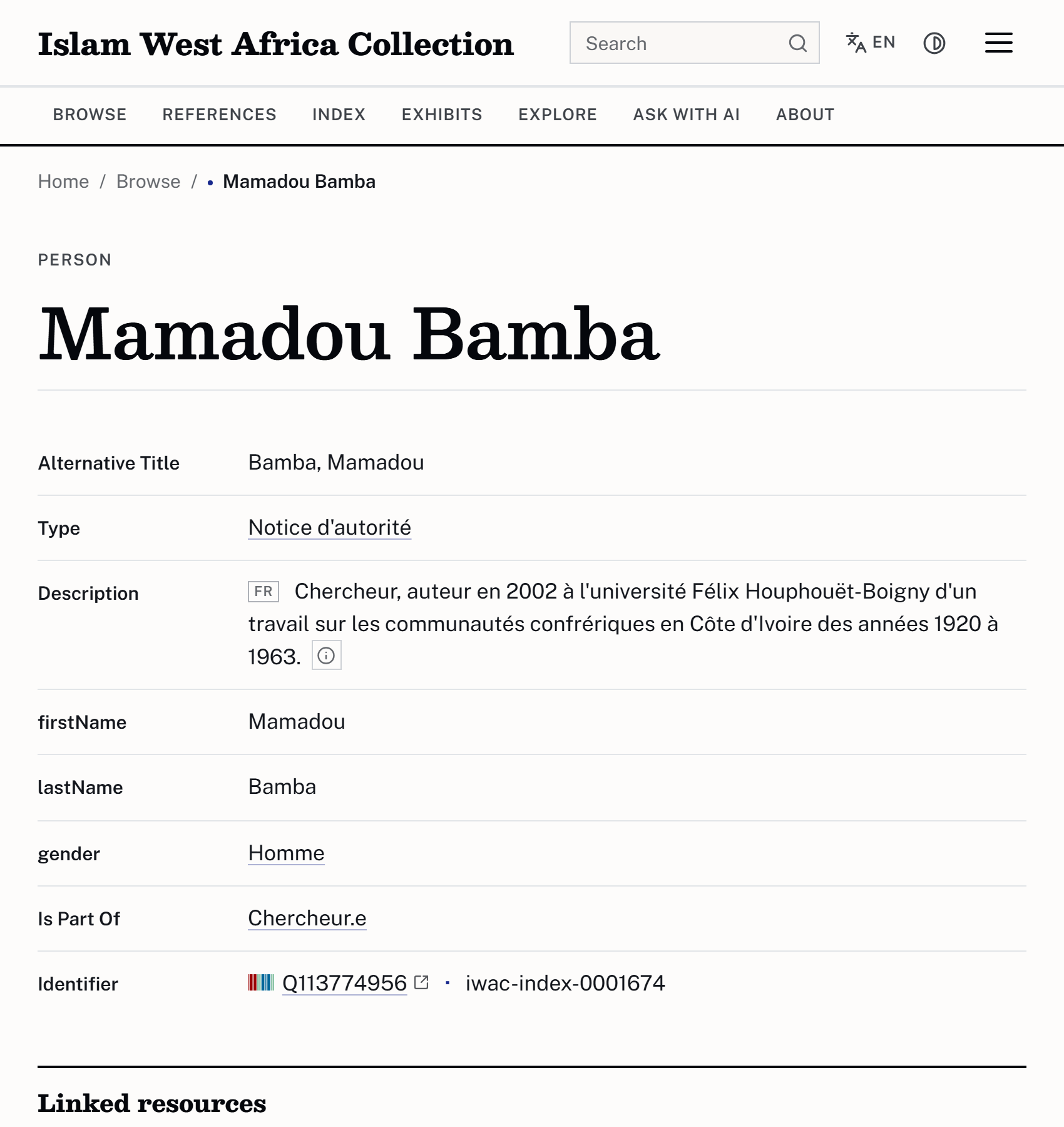
- Researcher Scholarly referenceAuthor of a 2002 work on Sufi orders in Côte d'Ivoire
Attached by name matching
- Politician Côte d'IvoireNational Assembly vice-president, 1989; foreign minister, 2003
- Lieutenant-colonel Burkina FasoAnnounced on television the dissolution of the Transition's bodies, September 2015
- Deputy imam of Yamoussoukro Côte d'IvoireLed the end-of-Ramadan prayer, 1986
One authority file, six countries
What a record asserts
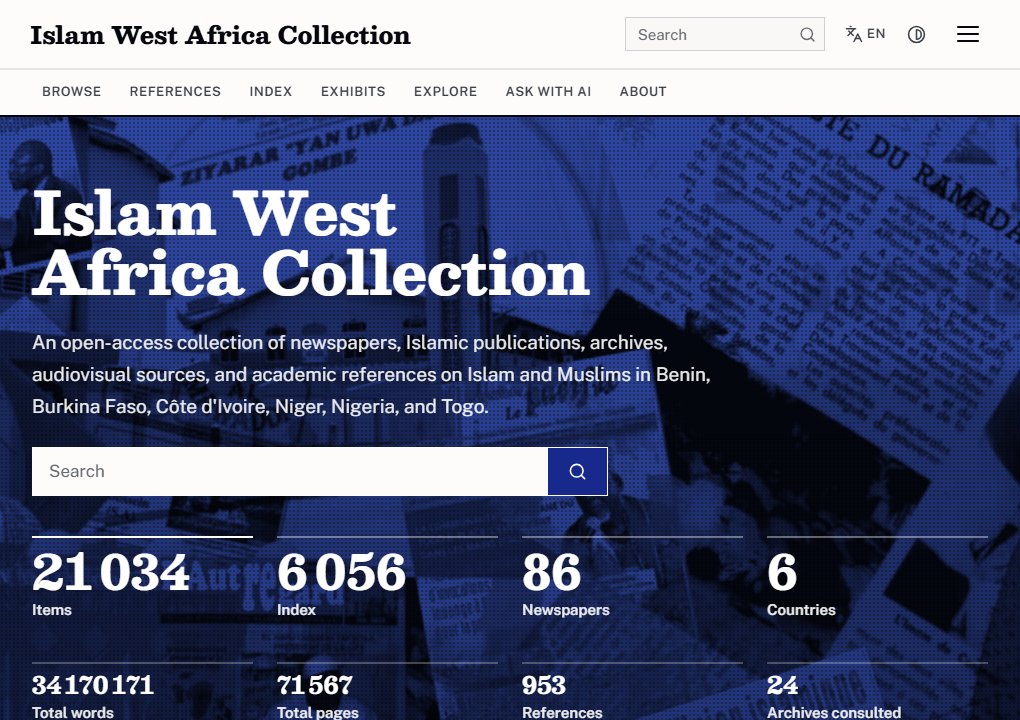
The Islam West Africa Collection
- Scope
- Open-access archive of Muslim public life in Benin, Burkina Faso, Côte d'Ivoire, Niger, Nigeria and Togo
- Holdings
- Press articles, Islamic periodicals, documents, audiovisual recordings, photographs, scholarly references
- Home
- Hosted at the Leibniz-Zentrum Moderner Orient (ZMO), Berlin; built and curated by one person
One curator, one authority file
Press articles, Islamic publications and scholarly references all link to the same set of records.
The same name in several countries
A script that matches by name turns each row into one entity.
| Name | Burkina Faso | Côte d'Ivoire | Benin | Scholarly author |
|---|---|---|---|---|
| Mamadou Bamba | Lieutenant-colonel, 2015 coup 188934 |
Politician; deputy imam 188930 188954 |
Researcher, 2002 1314 |
|
| Kassoum Coulibaly | Defence minister, 2023–24 127886 |
Cited 1982–83 67772 |
||
| Mamadou Traoré | Army colonel, 2007–09 127891 |
Ivorian namesake 23631 |
||
| Yacouba Traoré | Imam, Muslim community of Poni 127901 |
Ivorian namesake 64666 |
||
| Boukary Savadogo | Ambassador to Saudi Arabia 127895 |
Author 1295 |
||
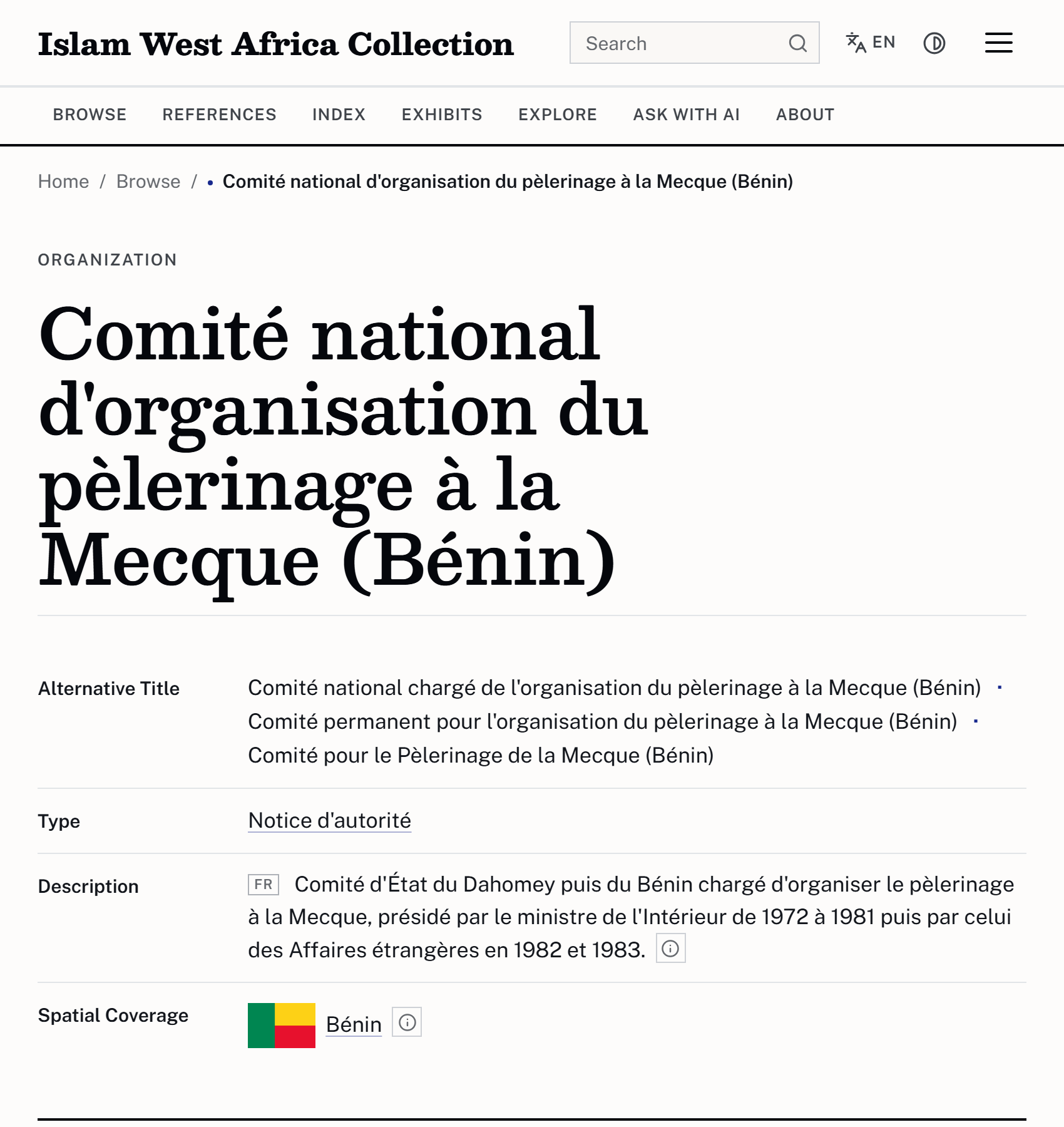
| CNOPM | Hajj commission, 1979–2018 579 |
Hajj committee, 1993–2007 23540 |
Hajj committee, 1972–83 127882 |
One imam, twenty names
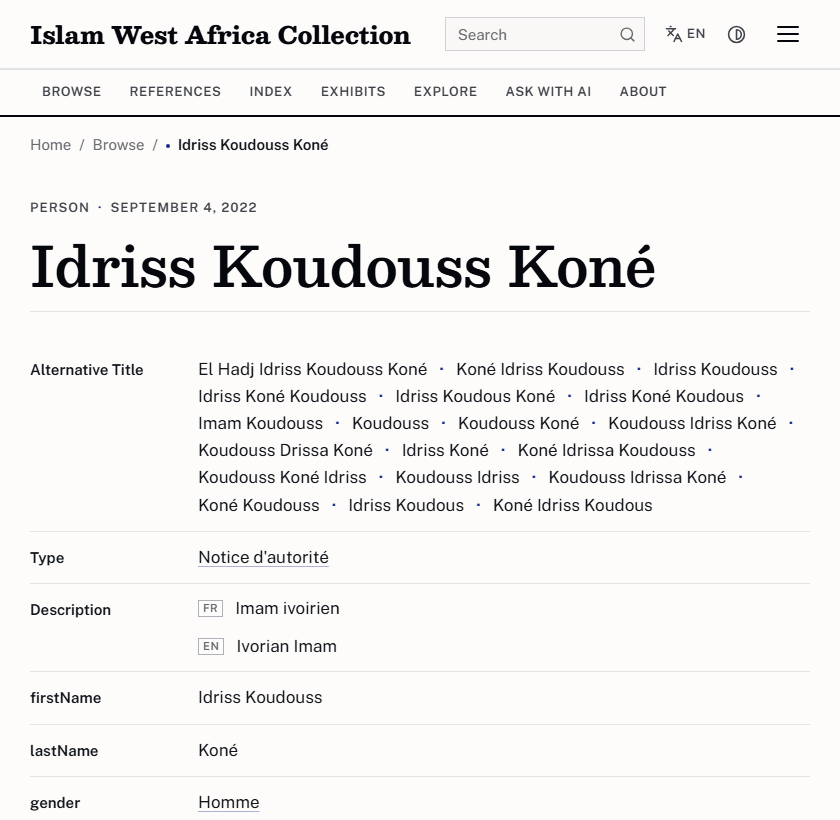
Nineteen alternative names on record 1057
- Word order
- Koné Idriss Koudouss · Idriss Koné Koudouss · Koudouss Idriss Koné · Koudouss Koné Idriss
- Honorific
- El Hadj Idriss Koudouss Koné · Imam Koudouss
- One s
- Idriss Koudous Koné · Idriss Koné Koudous · Idriss Koudous · Koné Idriss Koudous
- Given name
- Koudouss Drissa Koné · Koné Idrissa Koudouss · Koudouss Idrissa Koné
- Shortened
- Idriss Koudouss · Koudouss · Koudouss Koné · Idriss Koné · Koudouss Idriss · Koné Koudouss
The reverse also happens: one string for several things, as with foi and Danyi (case 3).
Mention, link and record
A string found in a source, at a date, in a context.
“Imam Koudouss”Asserts that one entity exists, under one preferred name, with a type and a country.
Idriss Koudouss Koné · person · Côte d'IvoireThe workflow
Which steps are model calls, which are code, which are agents
Five steps, and who acts at each
-
1
Extract
Model one call per article
Names of persons, organisations and places; one to six subjects.
-
2
Match
Code no model
Exact keys first. Ambiguous or fuzzy candidates are flagged, never linked.
-
3
Check in context
Model one call per article
Keep, choose or drop, only among the ids it was offered.
-
4
Write
Scripts no model
Dry run first. Each link annotated with its model:
iwac:nerModel. -
5
Leftovers
Agents then the curator
Reviewer agents propose new records. The curator approves each plan.
How the country is decided
- “Use the text first, the newspaper’s country second.”
- “A body of another country is not this one.”
- A contradiction is only “a different country, an incompatible calling … or dates that cannot fit”.
- “Choose only among the candidates of that entry. Never invent an id.”
- Name as found
- Kassoum Coulibaly
- Newspaper’s country
- Burkina Faso
- 67772Coulibaly Kassoum · person · Côte d'Ivoire
No description - 127886Kassoum Coulibaly · person · Burkina Faso
Minister of state, minister of defence
Keep Choose Drop: leave unlinked
Illustration of the input’s shape, not the transcript of a real call
The first full run, Burkina Faso
Claude Haiku 5.5. Extraction 20 October (1 h 38, about $6.50); leftovers 21 October; context check and write 22 October. From the pipeline changelog and run files.
Three cases
Where the workflow went wrong or could not decide
Case 1: one acronym, three countries’ committees
Case 2: the researcher and his namesakes
“Unknown” has to be representable
Authors and actors share one person set
Case 3: acronyms that are also words
The authority records hold 408 acronyms. Twelve are also common words in the articles.
FOIkeyF.O.Isame keyFoino keyfoino keyDanyi and Dankpen, read as Denmark
93 of 124
place links on Danemark (428) were Togolese agency reports, 2020–2024, naming the prefectures of Danyi and Dankpen
A pass older than the iwac:nerModel annotation. Nothing records which model or script made these links.
What stays human
One curator, some 50,000 links from one country run
Where the curator sits
- Rules before runsWritten by the curator, rewritten after reading what went wrong
- Ambiguity is never settled by codeThe model chooses among the records offered, or leaves the name unlinked
- Every new record is approved731 proposed in the first pass: 18 held back as possibly existing, 39 flagged
- Merges and splits are the curator’s59 merge pairs drawn from the reviewers’ remarks, withdrawn unapplied
- Agents never writeScripts do: dry run, backup of each item, dump of every payload
Who validates?
Not independent
Extractor and checker are both Claude Haiku 5.5.
Independent, but narrow
A full-text count overturned wrong drops: 4 on the FOI, 10 on other acronyms.
None yet
No hand-checked error rate for any country.
What escapes the loop is what no rule anticipated.
Four modelling decisions the cases forced
Country in the title
For generic bodies, identity includes jurisdiction.
Unlinked as an outcome
A mention may stay a mention when the source cannot settle it.
Provenance on each link
iwac:nerModel, iwac:descriptionModel: which model proposed this value.
Undated descriptions
Written today about articles decades old. Patched by a prompt rule; IWAC lacks a temporal marker.
Questions for the Alevi Archive
- Where does the identity of a person or a cemaat live, and who decides that two factoids are about the same entity?
- Can a probabilistic identification stay marked as such once it is in the graph?
- Is a check by the same model a verification at all? What would count as an independent one?
- When the source cannot settle an identity: an unlinked mention, a provisional record, or a “possibly the same as” relation?
Thank you
The curator approves records, merges and splits. The links still await a hand check.
Scan for these slidesslides.frederickmadore.com
Appendix
Held back for questions
How step 2 matches names
Code, no model. Looser keys are tried only once every exact key has missed.
- Exact keys: lower case, no accents, spaces or dashes
- A key shared by two records is ambiguous, never resolved
- Word order: “Coulibaly Kassoum” = “Kassoum Coulibaly”; never for initials
- Plural fold for non-person subjects; accents kept, “Jeunes” ≠ “Jeûne”
- Acronyms of 2–6 capitals get a case-sensitive key only
- “(Country)” titles are also keyed bare within that country’s run
Twelve acronyms that are also words
UN43,823 in lower caseFOI2,245AIDE971AUCARCETAITUNIRULSEMIADUPThe other ten acronym records had 722 item links; 579 name the record in full or in capitals. The model read the other 143, and a full-text check overturned ten of its drops (seven “Nations-Unies”, two Tidjania, one bishops’ conference). 108 links were removed, 99 of them “aide”.
When reviewers propose merges
- The Yirgou clashes into the village of Yirgou
- The arrest of Inoussa Kanazoé into the man
- The FAIB into the AIMB
- Nas-Air into Air Afrique
Event, place, person and organisation are types a language model blurs.
Further questions
- Should provenance sit on every link, and what does that cost in a factoid model where links are the data?
- How do you tell apart two people, or two ocaks, of one name in different regions? Is that decision a factoid, with a source and an author?
- Does every factoid pass a person, and would it still if the data grew tenfold?
What the first extraction prompt picked up
The revised prompt, tested on 18 articles: subject entries fell from 185 to 127, and “Islam” from 12 articles to none. The Burkinabè run used the first prompt; Togo, the revised one.