HKADH 2027 · Education University of Hong Kong, 21 January 2027
Knowledge gaps and mediated access
AI infrastructure and practice for African research data
Frédérick Madore, Jiayu Yang, Oliver Baumann, Neeraj Thandayan Viswajith, Durgesh Nandini and Mirco Schönfeld
Scan for these slidesslides.frederickmadore.com
A catalogue should define its own terms
Three goals: the Cluster’s agenda, taken to the catalogue
Say what a term means in the research we catalogue
Shift who describes: definitions drawn from that research
Keep each definition cited, dated and open to revision
The question
Can language models draft these definitions from AMIRA’s own holdings, with every claim traceable to a source? Does that do better than borrowing a definition, or asking a model alone?
“It is our contention that this approach allows us to transcend the limits of thinking in fixed categories and binaries.”
The Africa Multiple Interactive Research Atlas (AMIRA) is the research-data platform of the Africa Multiple Cluster of Excellence, University of Bayreuth (Germany). The material usually stays with the researchers, archives and libraries that hold it; the metadata is shared.
3,975Research items
106Projects
813Publications
28Languages
43Podcasts
142Videos
AMIRA MCP server, collection overview, 16 November 2026
The server, not the model, computes counts, facets and related records
Curator mode: private records and full text, behind a personal token
Code on GitHubgithub.com/AM-Digital-Research-Environment/amira-mcp-server
A label and a list, but no definition
data.africamultiple.uni-bayreuth.de/s/amira/item/3270Open record ↗
Records
55
Definition
None
Readers also need to know what a concept means and how the research catalogued in AMIRA uses it.
What a definition would add
What highlife means in the research AMIRA holds, each claim cited to an article.
Standard vocabularies identify a concept but rarely explain it
Library of Congress
Highlife (Music)
No scope note
Mbira music
A cataloguing instruction: “Here are entered compositions not in a specific form or of a specific type for solo mbira…”
Wikidata
highlife
“musical genre originating in Ghana”
timbila, a xylophone
Listed with the alias “thumb pianos”
id.loc.gov and wikidata.org, read 16 and 17 November 2026
The sources: ILAM’s journal African Music
The International Library of African Music (ILAM), at Rhodes University (South Africa), holds recordings, journals and photographs of music from across Africa.
1954–2023Years
45Issues
1,032Articles
935With full text
Definitions quoted from seventy years of research
Articles found by what they discuss
Vocabulary dated, article by article
AMIRA, ILAM collection page and full-text map, 16 November 2026. The full text is private.
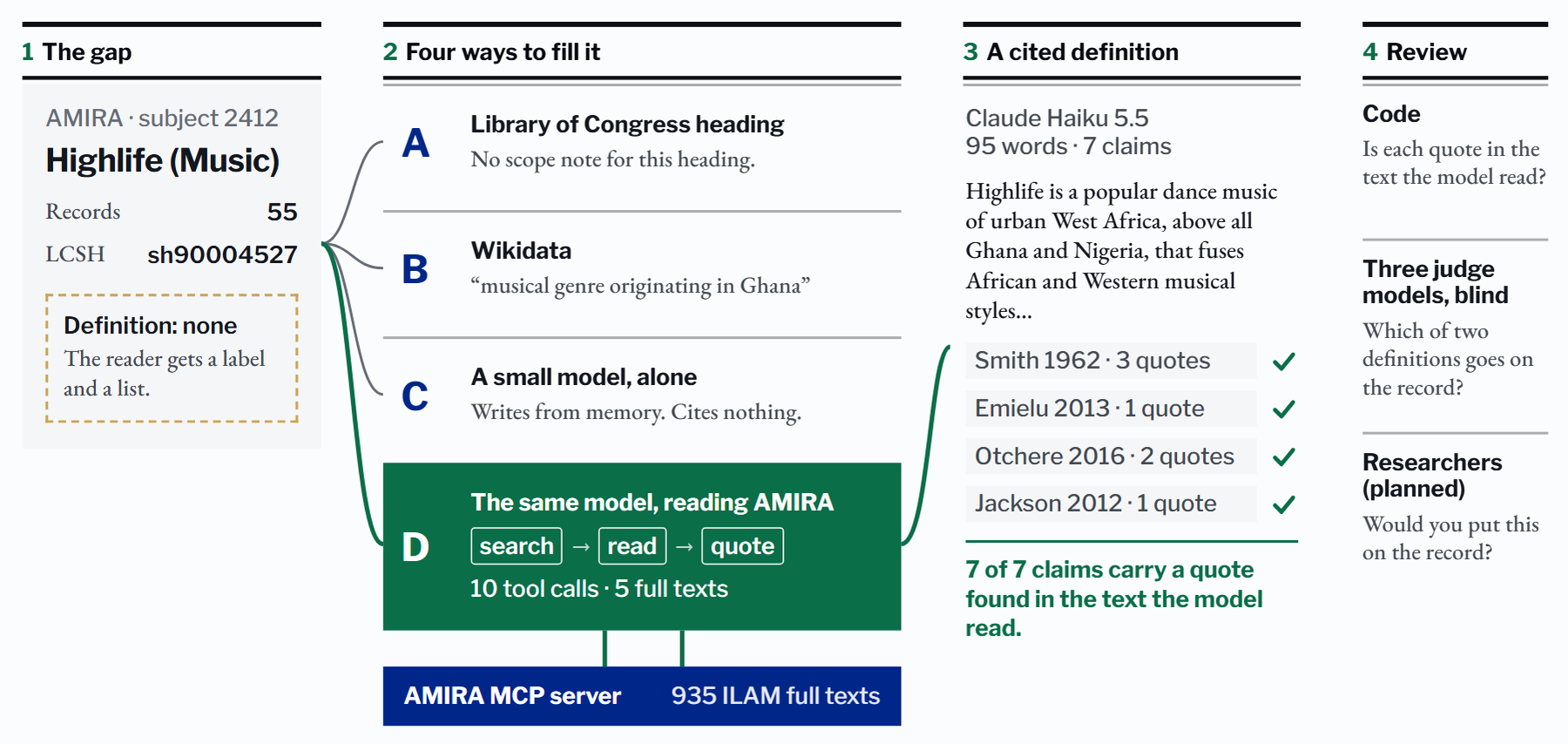
Definition: noneThe reader gets a label and a list.
A
Library of Congress heading
No scope note for this heading.
B
Wikidata
“musical genre originating in Ghana”
C
A small model, alone
Writes from memory. Cites nothing.
D
The same model, reading AMIRA
search→read→quote
10 tool calls · 5 full texts
AMIRA MCP server 935 ILAM full texts
Claude Haiku 5.5 95 words · 7 claims
Highlife is a popular dance music of urban West Africa, above all Ghana and Nigeria, that fuses African and Western musical styles…
Smith 1962 · 3 quotes
Emielu 2013 · 1 quote
Otchere 2016 · 2 quotes
Jackson 2012 · 1 quote
7 of 7 claims carry a quote found in the text the model read.
Code
Is each quote in the text the model read?
Three judge models, blind
Which of two definitions goes on the record?
Researchers (planned)
Would you put this on the record?
Highlife, defined from AMIRA’s sources
Highlife is a popular dance music of urban West Africa, above all Ghana and Nigeria, that fuses African and Western musical styles. Writers describe it as a compromise between African traditional forms and Western music, mostly sung in many vernaculars with simple, binary-form melodies. It emerged as a national rather than ethnic music in the 1950s.
Claim
Quote found in the text the model read
Source
1
“all represent this compromise between African traditional forms and Western music.”
7 of 7 claims carry a quote found in the text the model read.
Claude Haiku 5.5, route D, run of 16 November 2026. Sources: articles in African Music (ILAM), linked to their AMIRA records.
Four models reading AMIRA on highlife
Model
Origin given
Quotes found
Est. cost (USD)
Claude Haiku 5.5
Debated: Konkomba singing bands, several streams
7 of 7
0.014
GPT-6 Luna
Ghana, then across West Africa
3 of 3
0.014
Gemini 3.5 Flash-Lite
Local forms with brass band, jazz and ballroom
3 of 3
0.016
Mistral Small 4
Local forms with ballroom, brass band and Latin American music
1 of 5
0.029
Route D, one run per model, 16 November 2026. Costs estimated from list prices. Tool calls and what each definition adds: annexe.
One English name, three drums
Talking drum
57articles
One Wikidata item. Reading AMIRA, all three usable definitions name members: Yoruba dùndún, Akan atumpan.
Dùndún, Yoruba (Nigeria)
26articles
No Wikidata item. The Yoruba label “Dundun” sits on the Mande dunun, another drum.
Donno or dondo, Akan (Ghana)
9articles with “donno”
No Wikidata item. Alone, only one model of four placed it in Ghana.
Does one model keep the three drums apart?
Verdicts “distinct”: model alone 3 of 12; reading full texts 8 of 12; passages only 0 of 12, each naming the dondo merged with a Yoruba drum.
Articles: full-text matches in African Music (ILAM). Wikidata read 17 November 2026. Definitions: four models, one run per cell, 17 November 2026. Open verdicts, no answer key: Claude Opus 5.5, GPT-6 Astra, Gemini 4 Argon, 17 November 2026; uncalibrated; agreed on 11 of 12 sets.
Reading AMIRA won where the models knew least
Blind verdicts, uncalibrated
Model alone
Reading AMIRA
Known well: highlife, timbila
18 of 24
6 of 24
Three drums: dondo, dùndún, talking drum
6 of 33
27 of 33
The Cluster’s concepts: multiplicity, relationality, reflexivity
9 of 36
27 of 36
All eight concepts
33 of 93
60 of 93
The judges know what the models know
They score from their own training, the knowledge the model alone draws on. No researcher has calibrated them.
Claude Opus 5.5, GPT-6 Astra and Gemini 4 Argon chose between each author model’s two definitions, shown as text only. Definitions 16 and 17 November, verdicts 17 November 2026; one run per cell. All three judges agreed on 20 of 31 pairs. Talking drum: 9 verdicts, one grounded answer unusable.
Wikidata, extended but never contradicted
Wikidata: multiplicity
“philosophical assertion that there is more than one geo-historical trajectory, developed by Edmund Husserl, Henri Bergson, and Gilles Deleuze”
Reading AMIRA: GPT-6 Luna
“Multiplicity is a way of understanding African and African diasporic life-worlds as heterogeneous, coexisting, and mutually influential rather than as one uniform object or fixed category. …”
57 verdicts by the same judges
The grounded text extends or nuances Wikidata in every verdict; it never contradicts it, and never simply agrees. Multiplicity: another sense in 12 of 12. Talking drum: a category, not one hourglass drum, in 9 of 9.
Wikidata Q3860307, read 17 November 2026. Route D definition, 16 November 2026. Open comparison by the three judges, 17 November 2026; one run per cell.
Passages fit a small model’s window, at a price
Grounded runs
Full texts allowed
Passages only
Largest single call, median (tokens)
46,133
13,658
Runs whose largest call fits 32k
8 of 32
16 of 16
Est. cost, same 16 runs (USD)
0.377
0.121
Blind panel’s choice, 45 verdicts
38
7
The price
With passages only, all four models merged the Akan dondo with a Yoruba “dondon”: a short passage does not carry enough context to tell them apart.
Provider token counts. Full texts 16–17 November; passages (no whole texts, at most 12 tool calls) and panel 17 November 2026. One run per cell; panel uncalibrated; no open-weight model yet.
Three limits of the pilot
The judges know what the models know
They score from their own training, as the model alone writes from it, and no researcher has calibrated them. One marked down a 1962 spelling the model had quoted faithfully.
Keyword search finds a term only as written
Another language or spelling is missed unless the record carries it. Retrieval by meaning is not built yet.
Older sources, older words
6 to 7uses of “tribal” per 10,000 words, 1957 and 1962
Under 1 from 2007 to 2023, apart from one sparse year. Spellings date too.
“Tribal”: AMIRA MCP server, full-text map of 657 African Music articles, 16 November 2026. Every result in this talk: one run per cell.
What comes next in the pilot
1About 50 concepts
Chosen by family: lamellophones, xylophones, drums, popular genres. Three runs per cell.
→
2A local open-weight model
On the passages variant, which fits a 32k window: a 27-billion-parameter model, run locally.
→
3Review by researchers
Subject specialists assess the drafts and calibrate the judges.
“Would you put this on the record?”
→
4Retrieval by meaning
Behind the same server, so other languages and spellings are found.
Thank you
Reading the archive pays where it knows more than the models.
Frédérick Madore, Jiayu Yang, Oliver Baumann, Neeraj Thandayan Viswajith, Durgesh Nandini and Mirco Schönfeld
In Claude, ChatGPT or another assistant: “What does AMIRA hold on highlife?”
→
2The assistant picks a tool
From the tools’ descriptions: search, count, read a record.
→
3The server answers
Records, counts and passages from the catalogue, each linked to its page.
→
4The assistant writes
In its own words, ideally citing the records it received.
Who decides what
We decide which tools exist and what they return. The assistant and its provider decide what reaches the answer.
Four models reading AMIRA on highlife
Model
Tool calls
Full texts read
Claims with a quote found
Est. cost, list prices (USD)
Claude Haiku 5.5
10
5
7 of 7
0.014
GPT-6 Luna
18
6
3 of 3
0.014
Gemini 3.5 Flash-Lite
6
3
3 of 3
0.016
Mistral Small 4
10
6
1 of 5
0.029
Read with care
One run per model: anecdotes, not measurements.
Mistral Small 4: three quotes over the 25-word limit, one not found in the text it read.
Four definitions of highlife, read side by side
All four: an urban popular music of West Africa, chiefly Ghana and Nigeria, mixing African and Western forms.
Model
Origin
What it adds
Quotes found
Claude Haiku 5.5
Debated: Konkomba singing bands, several streams
Vernaculars; a national music by the 1950s
7 of 7
GPT-6 Luna
Ghana, then across West Africa
Variation by place and period
3 of 3
Gemini 3.5 Flash-Lite
Local forms with brass band, jazz and ballroom
“Intertribal” music; love and social commentary
3 of 3
Mistral Small 4
Local forms with ballroom, brass band and Latin American music
Harmony in thirds or sixths; mid-twentieth century
1 of 5
Route D, one run per model, 16 November 2026. Definitions of 80 to 102 words.

 Scan for these slidesslides.frederickmadore.com
 Code on GitHubgithub.com/AM-Digital-Research-Environment/